Extension & Enrichment
How St Mary's College extends high-ability students in Years 7–12: the Advanced Mathematics pathway, accelerated VCE units, Tournament of Minds, DAV debating, Olympiads and other competitions, and how students are identified.
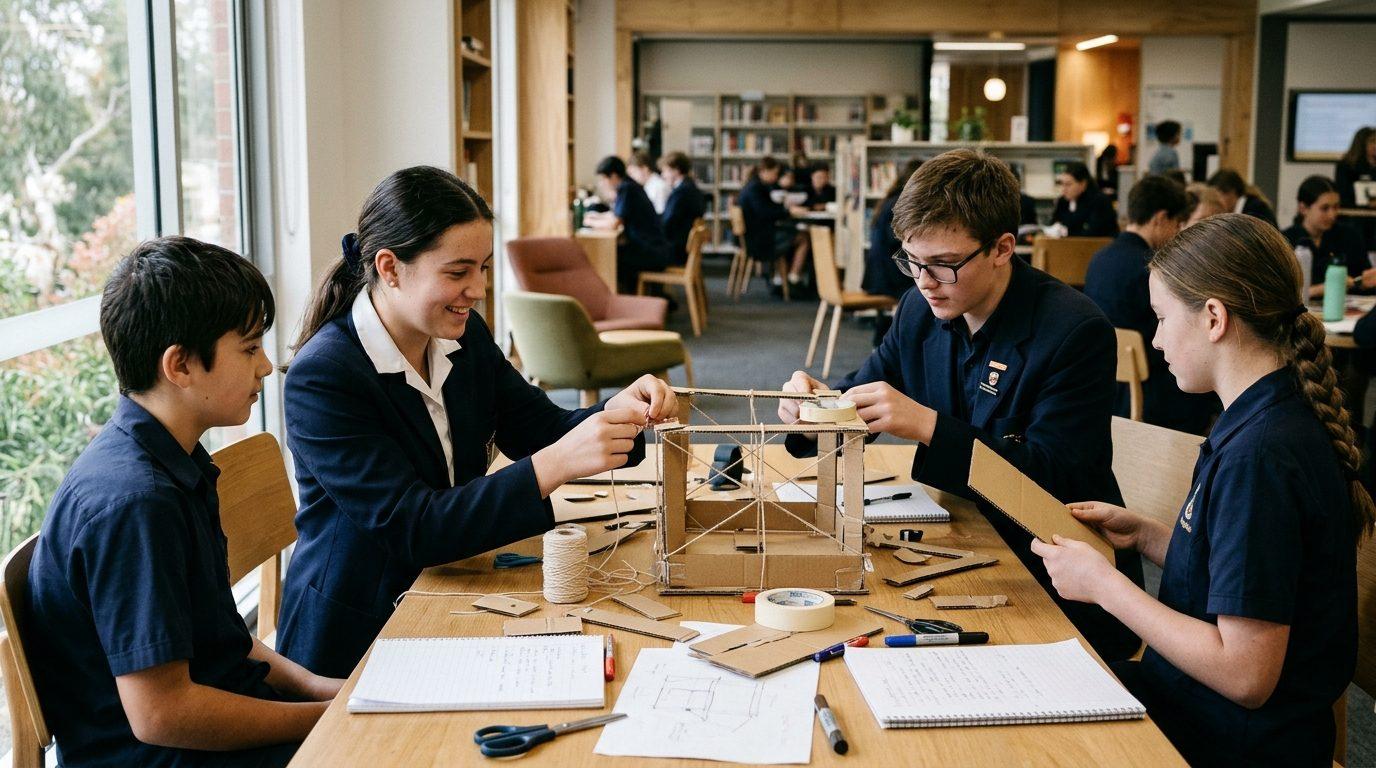
Some students need more than the standard course offers: they finish early, ask the question after next, or are quietly bored. St Mary's is not a selective school and does not run a separate "gifted" stream. Instead we try to notice these students early and give them harder work in class, a faster pathway where it is warranted, and competitions where they can meet their match. This page explains what is available in Years 7–12, who it is for and how a student gets in. Junior School extension is covered on Learning Support.
How students are identified
No single test decides it. We look for agreement between several sources:
- Assessment data — PAT Reading and Mathematics results carried over from primary school, NAPLAN in Years 7 and 9, and class results on the Learning Hub.
- Teacher nomination — subject teachers put names forward to the year-level coordinator each semester, including students whose ability shows in conversation more than on paper.
- Transition information — Year 6 teachers' handover notes, and reports from psychologists or other professionals supplied at enrolment.
- Parent or student request — a parent may ask for a review at any time through the Homeroom teacher. Students may ask too, and a good number do.
Deputy Principal – Learning & Teaching Mr David Okafor oversees the program, and Learning Diversity Leader Mr Sam Devlin writes a Personalised Learning Plan where a student needs significant adjustment. Identification is reviewed every semester; no one is locked in or out by a result at age twelve.
In the classroom
Most extension happens in ordinary lessons, through harder texts, open-ended tasks and the option to go deeper rather than simply do more.
- Mathematics is taught in three flexible groups from Term 2 of Year 7. The top group works towards the Advanced Mathematics pathway in Year 10, which is the preparation for VCE Mathematical Methods and Specialist Mathematics. Groups are reviewed each semester.
- Science students present an independent investigation at the Science Fair in Term 3.
- English runs a Wide Reading program in Years 7 and 8, and strong writers can choose the Creative Writing elective in Year 9.
The course structure is on Curriculum Years 7–10.
Accelerated VCE
| Stage | What is possible | How to apply |
|---|---|---|
| Year 10 | One VCE Unit 1–2 study, timetabled with Year 11 | Through course selection in Term 3 of Year 9, with a recommendation from the current subject teacher |
| Year 11 | One VCE Unit 3–4 study, sat with Year 12 | On the Year 10 Subject Selection Form, with written support from the current subject teacher |
Places are limited and depend on consistently high results, sound organisation and the timetable. For 2027, Year 11 acceleration places were confirmed by Friday 13 November 2026.
Acceleration is worth weighing carefully. A student who completes a Unit 3–4 study in Year 11 has experienced a VCE exam before Year 12; they also sit the General Achievement Test, the Year 12 practice exams for that subject and a VCAA examination a year early. It suits students who are ahead and organised. See Subject Selection — Year 10 and the VCE Handbook.
Competitions and clubs
| Program | Years | When and where | Staff |
|---|---|---|---|
| Tournament of Minds | 7–10 (and 5–6) | Wednesdays 3:30–4:30pm, Terms 2–3, Library Seminar Room | Ms Megan Carty |
| DAV Debating | 9–12; in-house Junior Secondary Program for 7–8 | Thursdays 3:30–4:30pm, Room S12 | Ms Rebecca Stroud |
| Robotics & STEM Club | 5–9 | Tuesdays 3:30–4:45pm, STEM Lab S3 | Mr Anthony Grech |
| Chess Club | 1–12 | Wednesdays at lunchtime, Learning Commons | Mr Greg Molloy |
| Mathematics and Science Olympiads | 9–11 | Preparation in class time and at lunchtime ahead of each paper | Mathematics and Science teachers |
Tournament of Minds puts teams of seven in front of an open-ended challenge in STEM, language literature, social sciences or the arts. They have six weeks to devise and rehearse a solution without adult help, and then a spontaneous problem to solve on the day. Teams are set at the start of Term 2, and the College pays the entry fee.
Debating in the Debaters Association of Victoria Schools Competition runs over five Thursday-evening rounds, the later ones on secret topics with one hour of preparation. Around 60 Senior students take part. Team registrations for 2027 open on Monday 1 February 2027 — see Debating.
Olympiads. Able students in Years 9–11 are invited by their teachers to sit the qualifying papers for the Australian Mathematics and Science Olympiad programs. These papers are deliberately very hard. Junior School students in Years 3–6 meet the same idea earlier through the Maths Olympiad extension group.
Robotics teams compete at RoboCup Junior Victoria, and chess players in the Victorian Interschool Chess Championships. See Robotics & STEM, Chess Club and the full list on Clubs & Activities.
Clubs are free apart from a $40 materials levy for Robotics and $25 per interschool chess event. All are open: a student does not need to be "identified" to walk in.
Scholarships and mentors
The Academic Scholarship (Year 7 entry) and All-Rounder Scholarship (Year 10) recognise exceptional ability; dates and criteria are on Scholarships & Bursaries. In Years 11 and 12, Lantern Mentors pairs students with Old Collegians working in the fields they are aiming for.
Contact
Deputy Principal – Learning & Teaching — Mr David Okafor Senior Office (03) 9555 0100 · Email office@stmaryswc.vic.edu.au · Monday–Friday 8:00am–4:30pm during term. Start with your child's Homeroom or subject teacher; for Personalised Learning Plans ask for Mr Sam Devlin, Learning Diversity Leader.